
Vehicle: 2012–2017 Honda Civic | 9th Generation (2012–2015) & 10th Generation First Years (2016–2017) Prompt Template Used: Prompt 2 — Ownership Cost & Value Angle Previous Generation Reference: 2006–2011 Honda Civic (8th Gen)
The Civic Math Nobody Shows You
The 2012–2017 Honda Civic is one of the most plentiful used cars in America. Walk onto any used lot, open any listing app, and you’ll find them — at prices ranging from $6,000 for a rough example with questionable history to $18,000 for a low-mileage 10th-gen Sport. That spread isn’t random. It tells you something important about how dramatically condition and generation year affect what you’re actually buying.
Here’s what most buyers get wrong: they see “Honda Civic” and assume the reliability badge covers everything in the listing. It doesn’t. The 2012 and 2013 model years, in particular, have a documented history of problems that Honda itself acknowledged — oil consumption complaints, early CVT shudder, and AC compressor failures that were not common in the generation that came before. Buy one of those without knowing the history, and you’ll be funding repairs that should have been the previous owner’s problem.
The buyers who get burned on this generation are almost always the ones who bought based on the Honda nameplate alone, skipped the pre-purchase inspection, and found out at 105,000 miles that the 1.8L engine was burning through a quart of oil every 2,000 miles. That’s a manageable problem if you know it’s coming. It’s a nasty surprise if you don’t.
Two Quick Answers
How much does it cost per year to maintain a Honda Civic?
For the 2012–2017 Civic, budget approximately $300 to $450 per year in routine maintenance if the car has been properly cared for and sits in the 70,000–120,000 mile range. That covers oil changes (Honda recommends 0W-20 full synthetic, roughly $50–$70 at a shop), cabin and engine air filters, brake fluid flushes every two years, and the occasional wiper set. Where costs spike is deferred maintenance — if you’re buying one where the previous owner stretched oil changes or skipped the CVT fluid service (which Honda originally said was “lifetime” fluid and then quietly reversed course on), you’re looking at an additional $150–$300 in catch-up work right out of the gate. The LX and EX trims on the 1.8L are the cheapest to maintain long-term. The Si with the 2.4L K24 costs slightly more per service but fails far less often, which tends to even out.
External Source What is the Honda Civic Maintenance Schedule?
Is the 2012–2017 Honda Civic cheap or expensive to insure?
Generally, this Civic sits in a low-to-moderate insurance tier — one of its genuine strengths as a daily driver. A base LX or EX on the 1.8L will typically land you in the lower 20–30% of insurance costs for its class, depending on your location and record. Where costs jump is the Si trim. Because the Si carries a sportier profile and attracts a younger average driver demographic, insurers price it noticeably higher — sometimes 25–35% more than an equivalent EX. The 2016–2017 Sport trim with the 1.5L turbo can also push rates up slightly due to the turbocharged designation, even though it’s not a performance car in the traditional sense. If insurance cost is a priority, the 1.8L LX or EX is where you want to be.
How This Generation Changed from the 2006–2011 Civic
The 8th-generation Civic (2006–2011) had a reputation it had genuinely earned. It was simple, predictable, and cheap to fix. Parts were everywhere. The 1.8L R18 engine that powered most of them ran cleanly, and the automatic transmission — a conventional 5-speed unit — was not a source of significant owner complaints.
When Honda launched the 9th generation in 2012, they changed a lot at once — and not all of it for the better, at least not initially. The CVT replaced the traditional automatic across most trims. That transition introduced complexity that the 8th gen didn’t have, along with a new failure mode: the early 9th-gen CVT was prone to shudder and vibration at certain speeds, particularly between 15 and 40 mph. Honda issued Technical Service Bulletin 13-019 to address it, which involved a CVT fluid drain and refill with updated fluid. Many owners reported significant improvement after the fix, but cars that never had it done — and there are plenty on the used market — will still exhibit the shudder.
The platform also became more electrically complex. The infotainment system, while improved over the 8th gen’s simple setup, introduced a touchscreen unit in higher trims that was criticized at launch for poor responsiveness — a complaint that hasn’t aged well and is now a maintenance item in its own right. Replacing or repairing a failed touchscreen on a 2012–2013 Civic EX-L costs more than the same repair on an 8th gen ever did.
From a parts cost perspective, the 9th gen did not meaningfully increase the cost of mechanical repairs over the 8th gen. Brakes, suspension components, and engine parts remain affordable and widely available. Where the cost equation shifted was in the CVT service requirements and the infotainment complexity — two areas where the 8th gen had no equivalent exposure.
The 2016–2017 10th-generation Civic was a genuine overhaul. Honda scrapped the 9th gen platform and rebuilt the car from a new architecture. The result was sharper handling, a more refined interior, and significantly better crash test ratings from both IIHS and NHTSA. The 1.5L turbocharged engine that debuted in the 10th gen was more powerful and more fuel-efficient than the old 1.8L — but it came with a new issue that didn’t exist in the 9th gen: oil dilution in cold climates. More on that in the engine section.
Looking at an older generation? Read our 2006–2011 Honda Civic Buyer’s Guide → Read the 2006–2011 Honda Civic Buyer’s Guide
Years to Avoid — and the One Year to Hunt Down
Avoid: 2012
The 2012 Civic is the year Honda would probably like to forget. It launched to near-universal criticism from automotive press — not for dramatic failures, but for being a step backward from the outgoing 8th gen. Build quality complaints were higher than any other year in this generation. Oil consumption on the 1.8L was most prevalent in early production runs. The CVT shudder issue was at its most common and least understood. And the AC compressor on 2012 models has a higher failure rate than any year that followed.
If you’re looking at a 2012 with high mileage and no documented service history, you are looking at the highest-risk year in this generation. That doesn’t mean every 2012 is a problem car — it means the odds are worse, and the price needs to reflect that.
Also watch: 2013
The 2013 improved on the 2012 but carried over most of the same mechanical DNA without enough time to fully address the oil consumption issue. Honda extended the powertrain warranty coverage for oil consumption complaints on these models after enough owners made noise — which is useful to know if you’re buying one that’s still within any extended coverage window.
Best year to target in the 9th gen: 2015
By 2015, Honda had refined the 9th gen substantially. The CVT fluid spec was updated and most surviving 2015s have either had the TSB performed or never exhibited the shudder in the first place. Oil consumption reports drop noticeably compared to 2012–2013. If you’re buying a 9th-gen Civic, the 2015 is where the value-to-risk ratio flips in your favor.
Best overall: 2016–2017
The 10th gen launch years are the clear choice if budget allows. These are fundamentally different and better cars than the 9th gen. The main caveat — the 1.5L turbo oil dilution issue — is real but manageable and primarily affects owners in cold climates who make frequent short trips. In moderate climates, it rarely becomes a significant problem.
Comparing the Civic to something else? See our Honda Accord Buyer’s Guide →Read the Honda Accord Buyers Guide
Engine and Transmission Combinations: The Cost Lens
1.8L R18A1/R18Z1 with CVT or 5-Speed Manual
This is what most 2012–2015 Civics on the used market are running. The 1.8L is a known quantity — modest power, solid fuel economy, and a long track record of high-mileage survival when maintained. The oil consumption issue that affected early 9th-gen production is real, but it’s not an engine-destroying problem if you check the level regularly and don’t run it dry. Oil changes every 5,000 miles with 0W-20 full synthetic (Honda Genuine or equivalent) is non-negotiable on these.
The CVT paired with this engine is the bigger cost variable. CVT fluid service — drain and refill with Honda HCF-2 fluid — should happen every 30,000–40,000 miles regardless of what any dealer told the previous owner. A CVT fluid service costs approximately $80–$120 at an independent shop. A CVT replacement, if it gets to that point, runs $3,000–$4,500 installed. That’s the expensive known single failure on this combination. Buying a 1.8L CVT Civic with 130,000 miles and no record of CVT service is a gamble. With documented service, it’s a reasonable buy.
The 5-speed manual paired with the 1.8L is the cheapest long-term combination in this generation. Manual transmission, no CVT complexity, easy to service. If you find a stick-shift 1.8L with honest miles, you’re looking at the lowest-cost version of this car to own.
2.4L K24Z7 — Si Models (6-Speed Manual Only)
The Si’s 2.4L K24 is a different engine family entirely — and a significantly more robust one. The K-series has a well-documented reputation for longevity. It’s not uncommon to find K24-powered cars with 250,000 miles that still run cleanly. Oil consumption is not a known issue on this engine. Parts are abundant, and the 6-speed manual that comes with it is one of the more durable transmissions Honda has produced.
The tradeoff: the Si costs more to insure, burns more fuel (expect 26–28 mpg combined in real-world use vs. 30–32 on the 1.8L), and commands a price premium on the used market. From a per-repair cost standpoint, the K24 is cheaper to maintain than the 1.8L CVT combination over the long run. From a total monthly cost standpoint (fuel + insurance), it costs more.
1.5L L15B7 Turbocharged — 2016–2017 Civic (CVT or 6-Speed Manual)
The 1.5T is the engine that divided opinions on the 10th gen. In moderate climates with mixed driving, it’s a legitimately good engine — more power than the 1.8L, better highway fuel economy (rated 42 mpg highway, with owners commonly reporting 36–39 in mixed use). The oil dilution problem is specific to cold-climate, short-trip driving. What happens: gasoline gets past the rings during cold starts and mixes with the engine oil, reducing its lubricating capacity. Honda extended warranty coverage and issued a software fix (TSB 17-082) in affected markets. If you’re buying a 2016–2017 1.5T in a cold climate, verify whether that software update was performed.
Turbo-related repairs on this engine are not inexpensive — a failed turbocharger runs $1,200–$2,000 installed — but turbo failures on the L15B7 are not common below 150,000 miles with proper maintenance. The CVT paired with this engine benefits from the same fluid service schedule as the 9th-gen unit.
2.0L R20A — 2016–2017 Civic (CVT or 6-Speed Manual)
The naturally aspirated option in the 10th gen. Less power than the 1.5T, slightly better real-world fuel economy in city driving, and none of the oil dilution concerns. If you’re buying a 2016–2017 Civic and don’t need the turbo’s highway passing power, the 2.0L is the lower-risk engine choice.
Don’t buy without checking the history first → Run a Free VIN Cheak
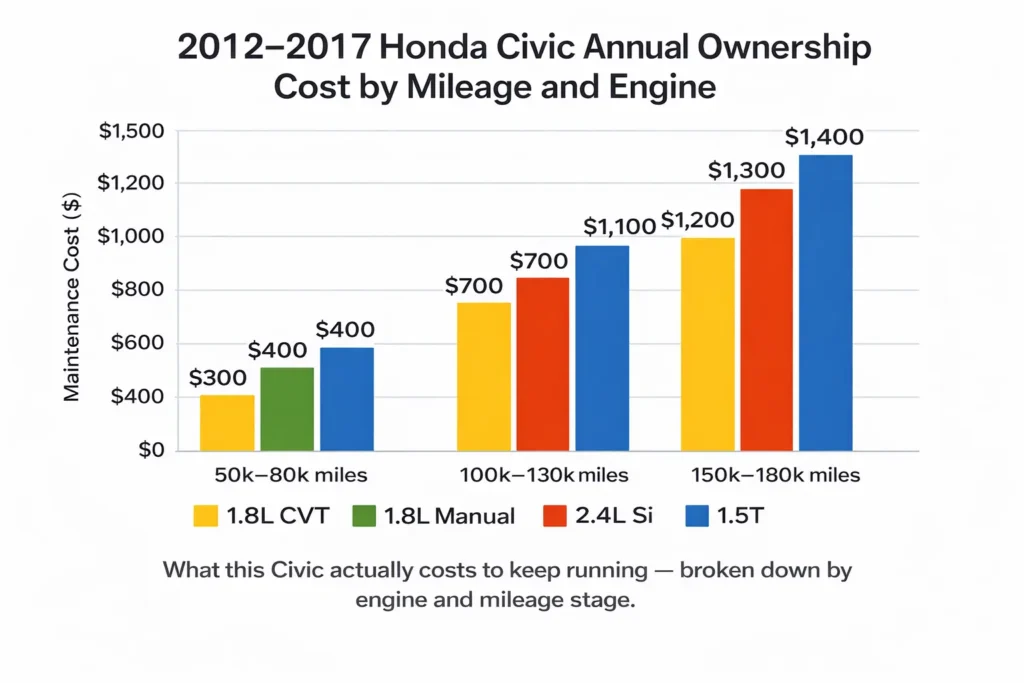
Total Cost of Ownership: Three Stages of Ownership
At Purchase (50,000–80,000 Miles)
At this mileage, a clean 2012–2017 Civic is in its most straightforward ownership window. Routine maintenance is the main cost driver: oil changes every 5,000 miles at $50–$70, brake pads if they haven’t been done ($150–$250 for a full front axle job at an independent shop), and a spark plug inspection at 60,000 miles ($120–$180 for a set of iridium plugs with labor). Annual maintenance cost at this stage: $300–$450.
Fuel: The 1.8L in mixed driving returns approximately 31–33 mpg. At current fuel prices, that puts annual fuel cost around $1,400–$1,700 for a 12,000-mile/year driver. The 1.5T does better on the highway but similar or slightly worse in pure city use.
Insurance: Low to moderate tier. Expect $80–$140/month depending on location, record, and trim. The Si sits on the higher end.
Tires: The base 195/65R15 is one of the most common tire sizes on the road. Budget tires start around $60–$70 each. Name-brand all-seasons run $100–$130 each. This is not a specialty tire situation. The Sport trim’s 17-inch wheels run 215/50R17 — slightly pricier but still a common size.
Mid-Ownership (100,000–130,000 Miles)
This is where the difference between a maintained car and a neglected one starts showing up in your wallet. On a properly maintained example, you’re looking at transmission fluid service (CVT: $100–$150, manual: $80–$120), coolant flush, and likely new tires if the originals are still on. Brake rotors often need replacement by 110,000–120,000 miles ($200–$350 front and rear at an independent shop).
The 9th-gen 1.8L may show increased oil consumption at this stage if it wasn’t addressed earlier. Catching it early means monitoring and regular top-offs. Missing it means potential piston ring wear that runs $1,500–$2,500 to address properly. On the 1.5T in cold climates, the oil dilution risk is at its highest if the software update hasn’t been applied.
Annual maintenance cost at this stage: $500–$800, depending on what’s been deferred. Repair risk climbs from low to moderate.
Late Ownership (150,000–180,000 Miles)
A well-maintained 2012–2017 Civic at 150,000+ miles is not unusual to encounter, and a significant number of them are still in solid shape. The risk profile changes here: you’re looking at potential water pump and timing chain service on the 1.8L (around $400–$600), possible alternator replacement ($300–$500), and on CVT-equipped cars, the transmission is approaching the mileage where a previously neglected unit may start exhibiting issues.
Owner-reported annual maintenance costs at this stage run $600–$1,200 depending on what comes up. The honest reality is that a car with documented service history at 160,000 miles costs significantly less to own annually than one where half the services were skipped. The documentation matters as much as the mileage.
Fuel economy typically drops 2–4 mpg from the EPA estimate at this mileage range due to engine wear, oxygen sensor aging, and injector carbon buildup — all manageable with routine maintenance but rarely addressed before a sale.
Common Questions About the 2012–2017 Civic
How much does it cost to repair a Honda Civic CVT transmission?
The CVT used in the 2012–2017 Civic is Honda’s HCTM unit. A full replacement runs $3,000–$4,500 installed at an independent shop, and closer to $5,000–$6,000 at a dealership. A rebuild, where available, typically runs $2,000–$3,000. Before assuming failure, however, have the fluid serviced first — Honda’s original factory fill was not designed for lifetime use regardless of what early documentation suggested, and many “failing” CVTs have been revived with a drain and refill using Honda HCF-2 fluid at approximately $100–$150. The shudder and hesitation complaints common to 2012–2014 models are frequently fluid-related, not hardware failure. If the unit still slips or overheats after a fresh fluid service, that’s when you start pricing a replacement.
Is the 2012–2017 Honda Civic worth buying in [current year]?
Yes — with a generation filter attached. The 9th-gen 2012–2013 requires more homework before purchase: verify CVT fluid service history, check for oil consumption by pulling the dipstick and looking for soot on the oil cap underside, and run a VIN report to confirm no flood or accident history. The 2015 9th-gen and all 2016–2017 10th-gen models are easier buys and represent strong value relative to their current used market pricing. The question isn’t really “is the Civic worth it” — it’s which year, which engine, and has the maintenance been done.
What are the 2012–2015 Honda Civic common problems and reliability concerns?
There are four issues that show up repeatedly in owner complaints and technical service bulletins on the 9th generation: CVT shudder between 15–40 mph (TSB 13-019, fluid-related in most cases), oil consumption on the 1.8L R18 engine (TSB 14-082, piston ring design), AC compressor failure (most common on 2012–2013, early production), and touchscreen responsiveness on EX-L and above trims. None of these are engine or transmission death sentences, but all of them are real — and none of them were common on the 8th-gen Civic that came before. The cars that avoided most of these problems were 2015 models and later, where Honda had time to address the root causes.
Used Honda Civic 1.8L vs 2.4L engine reliability — which one should I buy?
This is a legitimate decision worth thinking through. The 1.8L is quieter, more fuel-efficient, and cheaper to insure — but it carries the oil consumption baggage on 2012–2014 examples, and it’s paired with a CVT that needs regular attention. The 2.4L K24 in the Si is one of Honda’s most proven engine families. It doesn’t have the oil consumption issue, it’s more powerful, and it’s mechanically simpler — no CVT. The downside: Si models cost more to insure, burn more fuel, and are harder to find with low miles because they tend to be driven harder. If you’re a mechanically-inclined buyer who does your own maintenance, the Si is the better long-term bet. If you need the lowest possible monthly cost of ownership and don’t care about the sportier driving feel, the 1.8L manual or a documented 1.8L CVT is the right call.
What breaks first on a Honda Civic after 100k miles?
On the 9th-gen 1.8L, the three most common failure points in order of frequency are: CVT fluid degradation leading to shudder or performance loss, oil consumption on the engine itself (which shows up as needing a quart between oil changes rather than an outright failure), and AC compressor seizure. None of these are catastrophic if caught early. On the 1.5T in the 10th gen, oil dilution in cold climates is the primary concern at and after 100,000 miles — particularly if the TSB software update was never applied.
Does the 2012–2017 Honda Civic hold its value?
Better than most compact cars in its class, yes. Civics consistently depreciate more slowly than comparable Corollas or Sentras at equivalent mileage, and they hold value longer into high-mileage ownership. The 10th-gen 2016–2017 models held their value particularly well through the used car market surge of the early 2020s and continue to command a premium over equivalent 9th-gen examples. Trim matters: an EX or EX-L will retain more than a base LX, and the Sport trim (2016–2017) holds value well due to its appearance package. Silver, gray, and white tend to hold value slightly better than less common colors on this model.
Is the 2012–2017 Honda Civic worth buying at 150,000 miles?
Directly: yes, with the right engine and a documented service history. The 1.8L manual or the K24 Si at 150,000 maintained miles is a realistic buy. The 1.8L CVT at 150,000 miles requires a confirmed CVT fluid service history — without it, you’re inheriting unknown risk. The 1.5T at 150,000 miles in a cold-climate car warrants an oil analysis before purchase to check for residual dilution. A compression test on any of these engines at 150,000 miles is worth the $50–$80 a shop charges to perform it. A compression test showing consistent numbers across all four cylinders on a high-mileage Civic is a meaningful green flag.
What to check when buying a used Honda Civic — inspection checklist
Pull the dipstick first. On the 9th-gen 1.8L, a dark, sooty residue on the oil cap underside combined with oil that reads low between services means oil consumption is active. Check coolant color — should be blue-green Honda Long Life or pink Honda Type 2, not brown or rusty. Start the engine cold and listen for valve train tick in the first 30 seconds; some tick on startup is normal, tick that persists past two minutes at operating temperature is not. For the CVT, park on flat ground, put it in Drive, and let it idle — any shudder or vibration before moving is a red flag. Inside the cabin, press every button on the touchscreen (2012–2013 EX-L units go unresponsive with age) and check that the AC blows cold. Under the car, look at the front subframe corners and the area behind the front wheels for rust. Check the frame rails visually for any signs of straightening or repair. On test drive, the CVT should build speed smoothly with no hesitation between 20–45 mph.
KNOW WHAT YOU’RE PAYING FOR — RUN THE VIN FIRST
A Civic with hidden flood damage or a rolled-back odometer isn’t a deal — it’s a money pit. Oil consumption and CVT issues don’t show up on the surface. Before you hand over a dollar, pull the full vehicle history and cross-reference it with the condition you’re seeing in person.
→ Free VIN History Check — See What This Civic Is Hiding ← opens in new tab
Who Should Buy This Civic — and Who Should Walk Away
The Right Buyer for This Generation
The buyer who gets the most value from a 2012–2017 Civic is someone who does basic maintenance themselves or uses a trusted independent Honda shop rather than the dealership. CVT fluid changes, oil changes, and air filters are straightforward jobs on this car. If you’re willing to do even two of those three yourself, you’ll cut annual maintenance costs by $150–$200 compared to full dealership servicing — and on a car that’s already cheap to maintain, that adds up.
A daily commuter putting 12,000–15,000 miles per year on a 1.8L EX or 10th-gen Civic will have a hard time finding a cheaper reliable car to operate. Fuel costs are low, insurance is low, and the parts ecosystem for this car is as mature as it gets in the used market. If the priority is cost-per-mile, this generation delivers.
The buyer targeting a 2016–2017 Si with the 1.5T who wants a slightly more engaging drive without entering sports car territory also gets strong value here — as long as they’re not in a cold climate making constant short trips, where the oil dilution risk is real.
Who Should Walk Away
If you’re buying a 9th-gen 2012–2013 Civic with high mileage and no service records, walk away — or negotiate the price down aggressively enough to fund a CVT service, an oil consumption diagnosis, and a full inspection before you consider it a good deal. This isn’t a car where the Honda badge alone justifies a leap of faith on a sketchy history.
If you’re looking for a vehicle to tow, haul, or carry more than four adults comfortably, this isn’t the right car regardless of generation. The Civic is an efficient urban and suburban commuter. It is not a workhorse.
If you’re someone who goes 8,000 miles between oil changes and considers tire rotations optional, the CVT in this generation will penalize you for it. The 9th-gen CVT is not forgiving of neglect. This car rewards attentive owners and punishes casual ones.
Value Score: Where This Generation Sits
8 out of 10
The 2012–2017 Civic earns an 8 when scored purely on value for money — parts availability, cost to maintain, fuel economy, and resale trajectory. The 10th-gen models alone could carry a 9, but the troubled 9th-gen launch years pull the generation average down. The 1.8L CVT combination is widely available and genuinely affordable to own properly — it’s just not forgiving of the neglect that many used examples have experienced. Find a documented, well-maintained example and this generation is one of the strongest value propositions in the compact used car market. The caveat: you have to do the homework to find one of the good ones, because the bad ones look identical from the outside.